On Wednesday morning, Bitcoin was still hovering around the $83,000 mark. According to reports, analytics firm CryptoQuant warned that short-term traders’ on-chain unrealized profit has hit a 21-month high, suggesting the market may be due for a pullback [1].
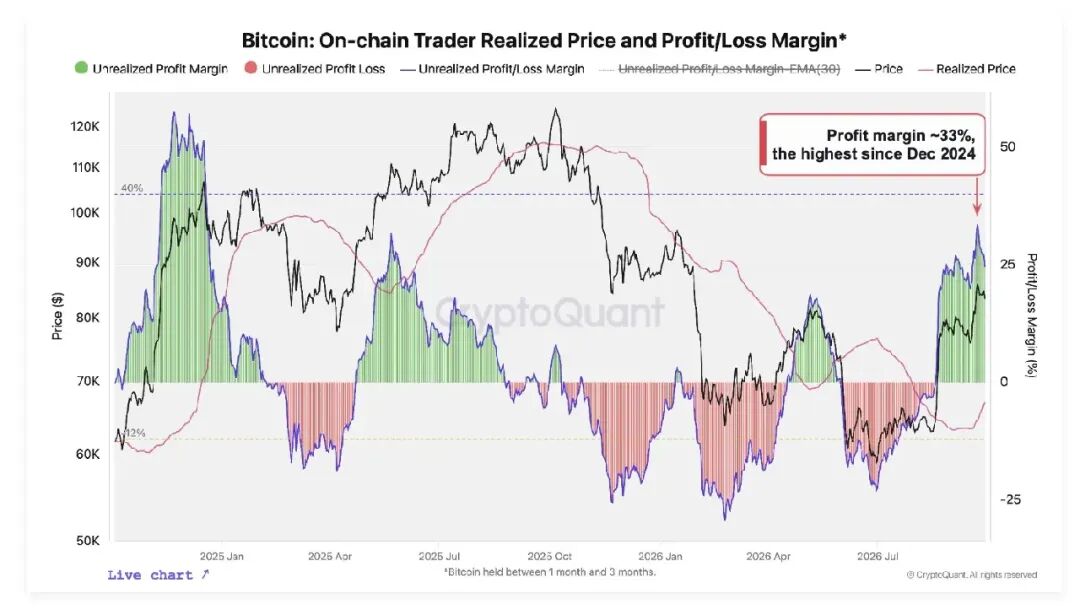
The logic is straightforward: the thicker the paper profit, the stronger the temptation to take it. With book profits piled up to a near two-year peak, CryptoQuant’s warning at this moment is essentially a bet on that urge to take profit.
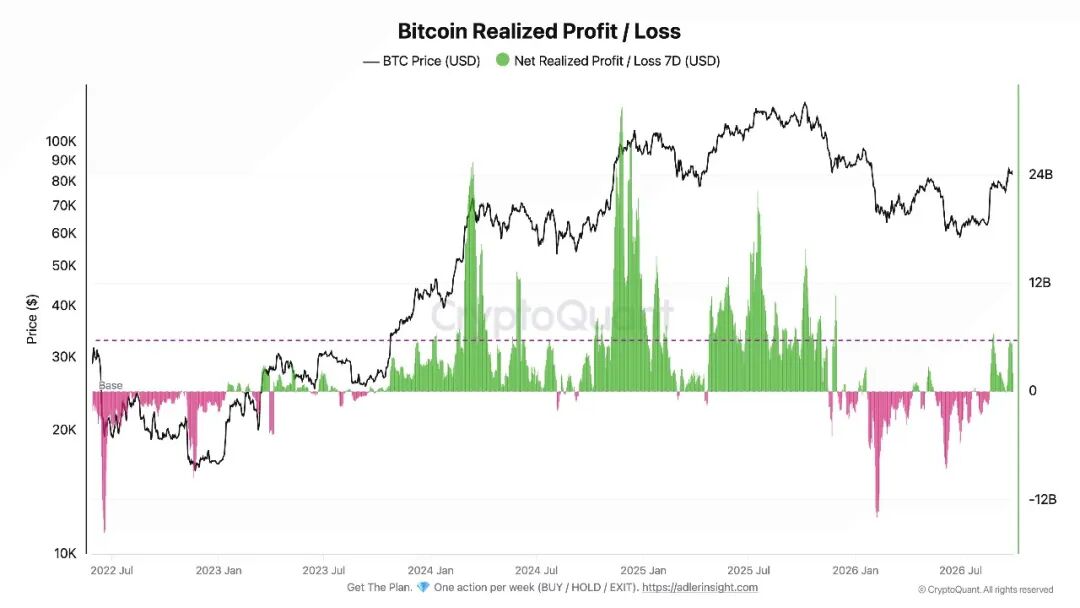
Yet on the very same day, two other datasets from the same firm point in the opposite direction. Per CryptoQuant analyst @axeladlerjr, the 7-day realized profit at the September 24 local top was 19% lower than the one at the August 26 top, while realized losses narrowed in tandem [2]. Prices were higher, but the amount being cashed out was smaller.
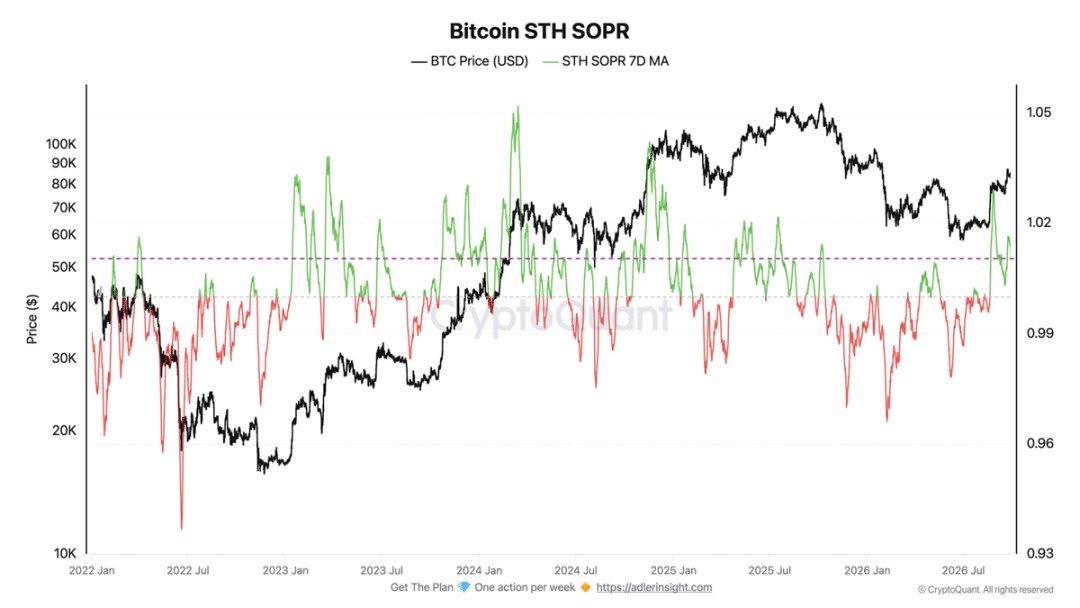
The Short-Term Holder SOPR (Spent Output Profit Ratio) — the gauge of short-term traders’ profit and loss — compressed from 2.8% down to 1%, yet never fell below 1. Profit was simply thinning, not turning into a loss [2].
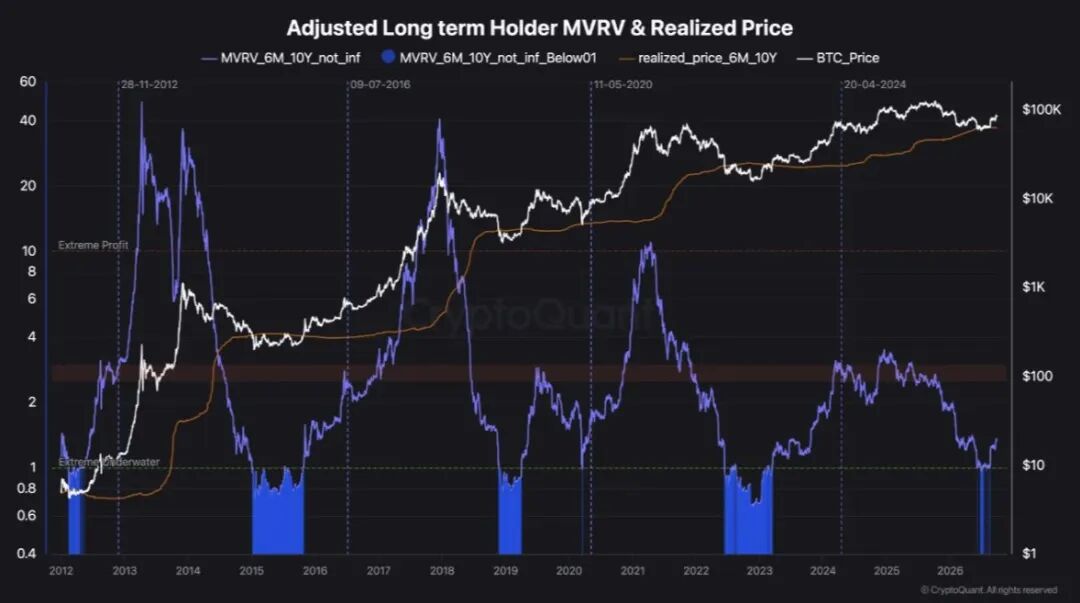
On the other hand, long-term holders have just emerged from a shallow stress zone. Per analyst @zizcrypto, the adjusted LTH MVRV has returned to 1.35, meaning spot price sits roughly 35% above this cohort’s cost basis; between June and August it dipped below 1 five times, each time only briefly, and each dip was characterized as a healthy correction followed by recovery [3].
However — and this is the part that demands the utmost attention — as has often been said, every technical indicator is a lagging indicator of price. The unrealized-profit metric is no exception. Why does the data show unrealized profit spiking? Simply because prices rebounded sharply from mid-August onward.
The more fundamental reason: since the market topped out in October 2025 and turned bearish, realized profit kept declining, dragging the cost basis down. With the cost basis lowered and prices then exploding upward, unrealized profit naturally surged in lockstep.
But does a synchronized surge in unrealized profit necessarily mean the bulls will be unable to resist the temptation to take profit and dump? Not at all.
There are two paths to reducing unrealized profit: one is to take profit by selling, pushing the price down; the other is to buy higher and add to positions, piling the cost basis upward. We must not fixate on the former while deliberately or inadvertently ignoring the latter.
On the very first chart above, back in May–June 2025, unrealized profit also reached a local peak. Did the price then retreat? No. Instead it kept charging higher, surging ahead. As the price continued to climb in fits and starts, with high-level turnover pushing the cost basis steadily upward, unrealized profit kept declining. This persisted for the better part of a year, until October 2025, when price made a new high while unrealized profit fell back to nearly zero — the two forming a pronounced divergence. Only then did the market begin to unravel: price crashed, and unrealized profit rapidly flipped into an ever-widening loss, marking the beginning of the harvest phase.
The warning and the counter-evidence are two sides of the same on-chain data. It is true that the floating-profit positions are thick; it is also true that price went higher while selling was lighter. What actually turns floating profit into a downturn was never the profit itself, but the deterioration line where STH SOPR falls below 1 and realized profit-and-loss turns negative. In the September 17 pullback to $76,500, that ratio bottomed at just 1.003 before rebounding [2].
This does not conflict with the broader picture: above, a wall of roughly one million coins near $86,000 still exerts resistance; below, a cohort of holders is sitting on profits they have not yet sold.
Between taking profit and patiently holding lies a vast distance — the journey from a bear-market mindset to a bull-market one.
References
- [1] CryptoQuant on-chain metrics — short-term holder unrealized profit reached a 21-month high as of late September 2026.
- [2] @axeladlerjr (CryptoQuant analyst) — 7-day realized profit comparison (September 24 vs. August 26) and Short-Term Holder SOPR readings.
- [3] @zizcrypto — Adjusted Long-Term Holder MVRV analysis (recovered to 1.35).