Recent industry research has zeroed in on a new security question for Bitcoin: which coins are actually exposed to quantum risk right now, in their current holding state? The core test is whether the public key needed to spend a coin has already been revealed on-chain. By that measure, roughly 6.04 million BTC — 30.2% of total issuance — currently sit behind public keys that are already visible on-chain [1]. The remaining 13.99 million BTC (69.8%) keep their public keys hidden while dormant, and are not exposed under this model. (A subsequent update from the same researcher on October 8 later revised the exposed figure to 6.26 million BTC, or 31.2% of supply [2].)
We can split the risk into two kinds. The first is structural risk: the script type itself leaks the public key on-chain. The second is operational risk: coins that were once protected but whose public keys have since been exposed through address reuse, partial spends, or custody practices.
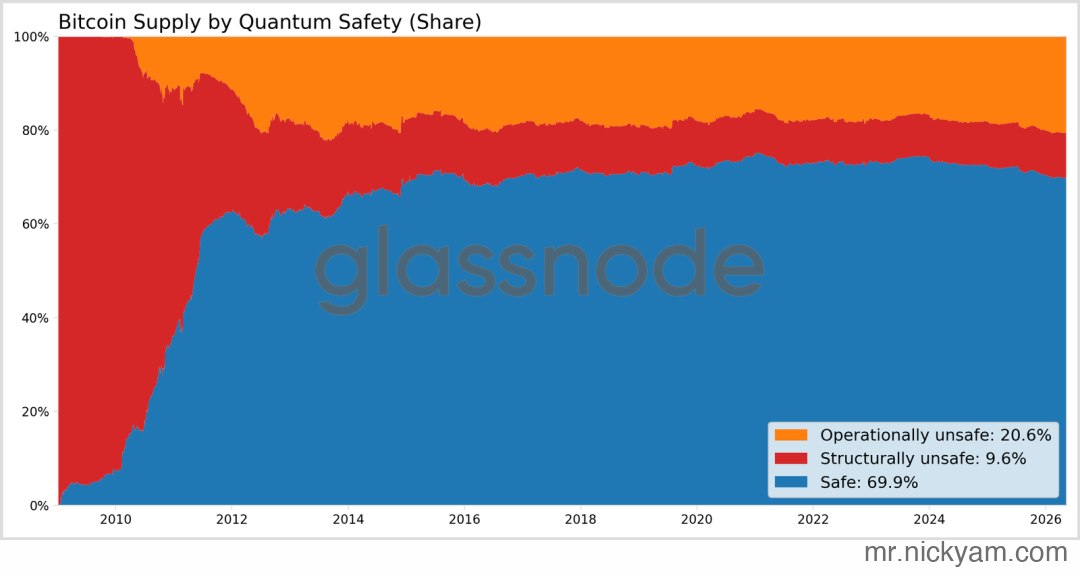
Bitcoin supply by quantum safety (share). Safe: 69.9%; structurally unsafe: 9.6%; operationally unsafe: 20.6%. Source: Glassnode.
Of the total, 1.92 million BTC (9.6% of issuance) carry structural risk and 4.12 million BTC (20.6%) carry operational risk. Exchange custody alone accounts for about 1.63 million BTC — a reminder that wallet hygiene and custody design matter as much as protocol design in limiting public-key exposure.
This analysis takes no position on when a practical quantum attack might arrive, and makes no judgment about the security or solvency of any custodian. It only quantifies the current state of public-key exposure, separating permanently high-risk coins from those whose risk can be reduced with better wallet and custody practices. Read it as a measured exposure statistic, not a countdown — a distinction we explored in our piece on shattering the quantum FUD.
Public-key exposure, in plain terms
A bitcoin balance is controlled by a private key; the public key lets the network verify that a signature came from that private key. Under classical cryptography, a public key alone cannot be reversed into a private key, so a hidden public key is enough to keep coins safe.
The quantum threat works differently. A cryptographically relevant quantum computer could run Shor’s algorithm to derive a private key from a known public key — the core worry we have tracked in our coverage of the quantum sword, honed by AI. That turns the on-chain question into a simple one:
- If the public key is already public, the coins are exposed. An attacker does not need to wait for the owner to move them — the public key is already available.
- If the public key is not visible on-chain, the coins are not exposed under this static storage model.
The focus here is on dormant balances: coins sitting still while their associated public keys have already leaked. That is different from transfer-time exposure, where a public key is only revealed when a transaction is broadcast and confirmed — a settlement-window risk rather than a stock of measurable risk. When a coin is called “safe” in this article, it means only that its public key has not been exposed while at rest — not that it is immune to every future quantum attack model.
Structural exposure: unsafe by design
These coins are exposed because of their address script format, regardless of how carefully the owner uses their wallet. The category covers Satoshi-era P2PK addresses, legacy multisig P2MS addresses, and today’s mainstream Taproot addresses. The vintages and use cases differ, but the common trait is the same: the public key — or an equivalent — is published on-chain from the start. As long as the coins are unspent, they are potential targets.
We currently classify 1.92 million BTC (9.6% of issuance) as structurally at risk, in three distinct cohorts:
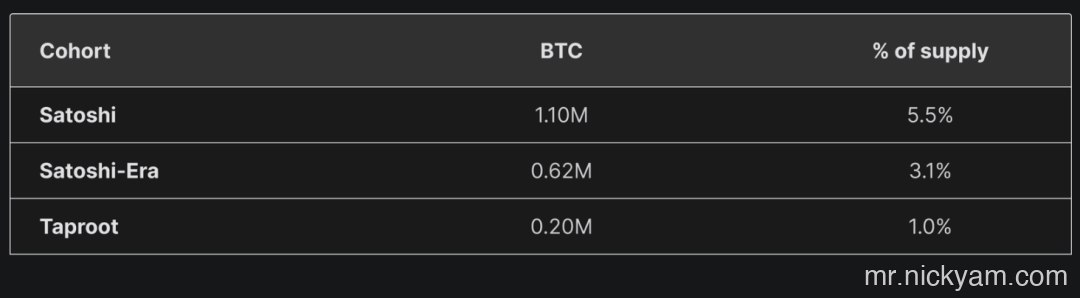
Structural risk cohorts: Satoshi 1.10M BTC (5.5% of supply), Satoshi-era 0.62M BTC (3.1%), Taproot 0.20M BTC (1.0%).
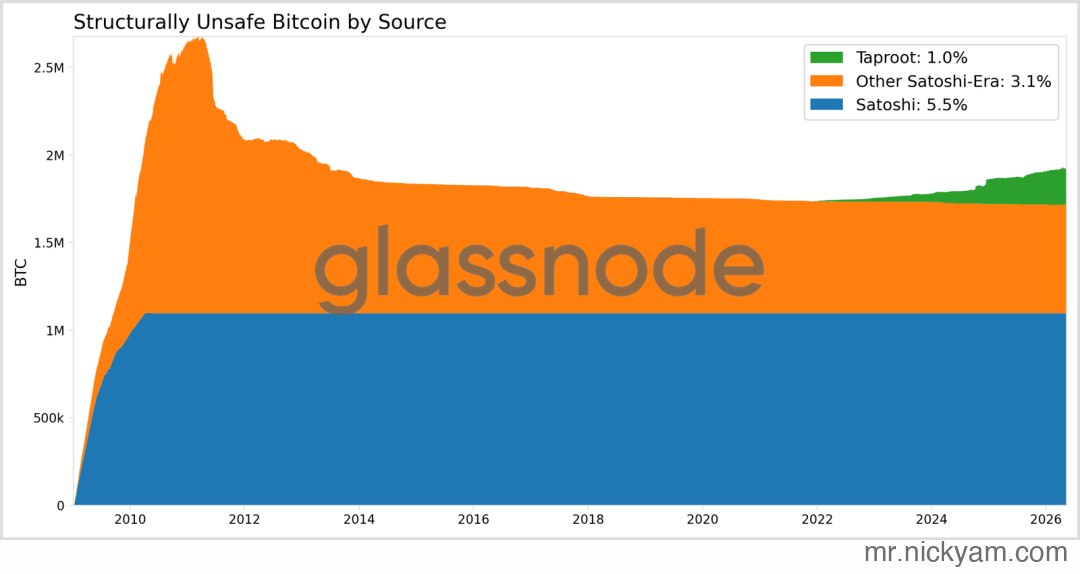
Structurally unsafe Bitcoin by source. Source: Glassnode.
Satoshi and early-block coins are permanently exposed. If they are lost or their holders are silent, there is essentially no way to migrate them to safe addresses — unless the whole network reaches consensus on a protocol-level fix, they will stay exposed to quantum risk indefinitely. What should happen to this stock, and who gets to decide, is precisely the question at the heart of Bitcoin’s quantum dilemma.
Taproot addresses are a different story. The script has real advantages — strong privacy, efficient transfers, flexible smart contracts — and is not a design flaw. But from a public-key exposure standpoint, Taproot publishes its key directly, leaving dormant balances exposed.
The industry’s proposed answer is BIP-360’s P2MR output type [3], which keeps Taproot’s functionality while removing the high-risk key-path spend. It cannot, however, auto-migrate existing Taproot balances, and it is not a complete post-quantum solution on its own [4].
In short, of the 1.92 million structurally exposed coins, one part is nearly impossible to migrate, while the rest can be progressively de-risked with new protocols and standards.
Operational exposure: unsafe by habit
These addresses are born with privacy protection — they do not leak public keys at rest. Exposure only happens when the owner’s own actions reveal the key mid-spend, leaving the remaining balance unprotected.
This is the address-reuse problem. Output types like P2PKH, P2SH, P2WPKH and P2WSH hide the public key behind a hash while the coins sit still. But once a spend reveals the public key, every balance tied to that key — present and future — loses the protection.
Operational exposure is now the dominant source of Bitcoin’s quantum risk: 4.12 million BTC, 2.1x the structurally exposed stock. It confirms that most of Bitcoin’s quantum exposure today is not a legacy scripting problem but a key-management and address-hygiene problem.
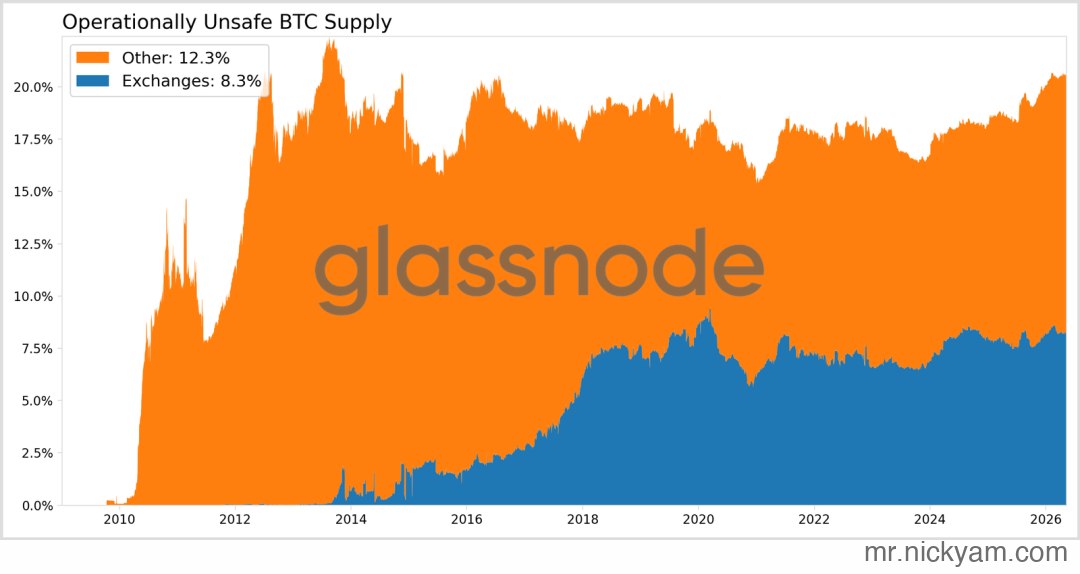
Operationally unsafe BTC supply: other 12.3% of total supply, exchanges 8.3%. Source: Glassnode.
Within the operationally exposed stock, exchange custody looms large: about 1.66 million BTC, roughly 40% of all operationally unsafe balances. The data also shows a stark split — about half of labeled exchange holdings are exposed, versus under 30% for non-exchange holdings.
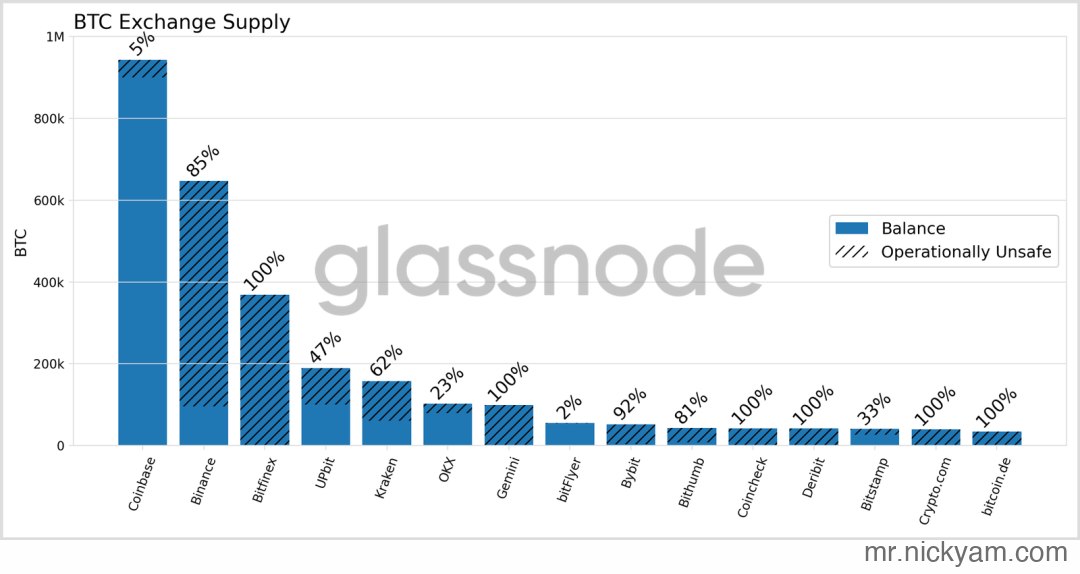
BTC exchange supply by platform, with the operationally unsafe share of each balance hatched. Source: Glassnode.
The custodian spectrum
Exposure varies enormously across institutions. Some custodians run relatively clean address books; others hold a large share of their balances in addresses with known public keys.
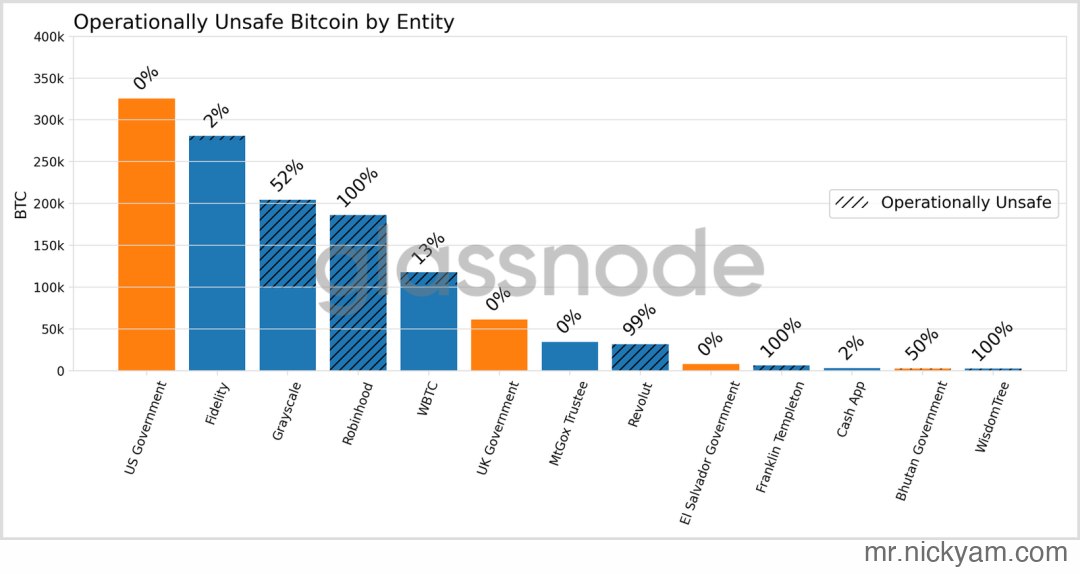
Operationally unsafe Bitcoin by entity. Source: Glassnode.
- Low risk: Coinbase has only ~5% of custodial assets with exposed public keys; sovereign treasuries (US, UK, El Salvador) show 0% exposure.
- Medium risk: Fidelity and Cash App around 2%; Grayscale around 50%.
- High risk: Binance 85%; Bitfinex 100%; Robinhood and WisdomTree fully exposed.
Note: these figures reflect on-chain custody traces only. They are not a risk rating, a solvency judgment, or a statement about any institution’s safety.
Over the long run, governments have kept 99%+ of their holdings safe, while exchanges — with high fund turnover and complex wallet architecture — have seen their safe share slide from 55% in 2018 to about 45% today. The encouraging part: this is the most fixable category. Basic discipline — never reusing addresses, promptly sweeping change to fresh addresses — can shrink the exposed stock quickly.
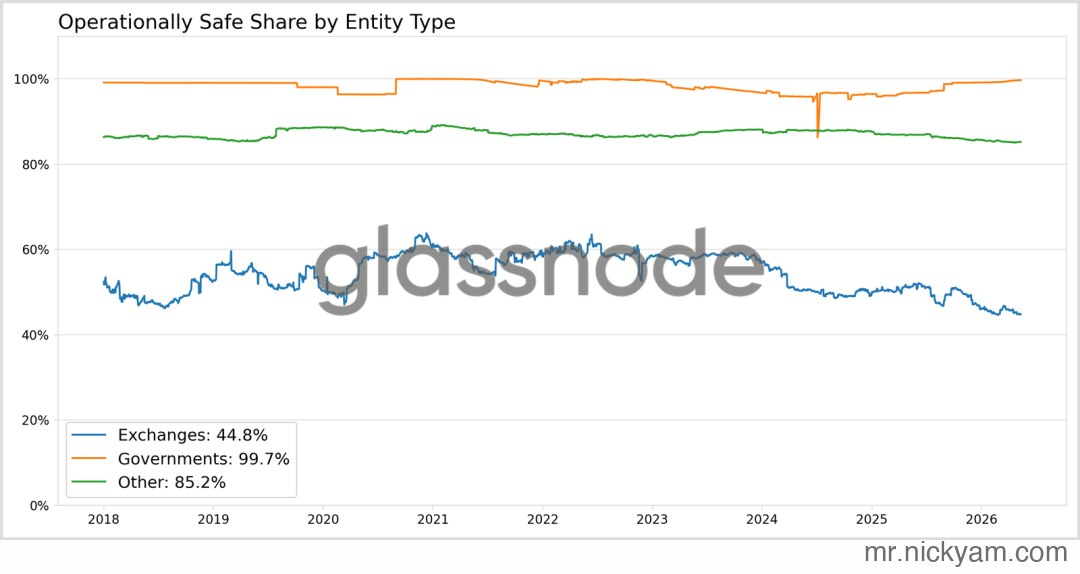
Operationally safe share by entity type: exchanges 44.8%, governments 99.7%, other 85.2%. Source: Glassnode.
The takeaway
Bitcoin’s quantum risk splits into categories with very different implications.
Structural risk: legacy coins are extremely hard to migrate; new protocols like P2MR can progressively de-risk modern Taproot addresses.
Operational risk: larger in size, but far more controllable — and the exchange-held stock is large enough that coordinated migration is realistic.
The broader lesson: quantum safety is not only a protocol-upgrade story. A large share of the exposed stock could be reduced today with ordinary operational discipline. For exchanges and professional custodians, disciplined address use, better reserve-address design, fewer key reuses, and a concrete migration plan are not distant ideals — they are practical, available-now ways to shrink quantum risk.
References
- [1] ForkLog — Glassnode Assesses Bitcoin with Exposed Public Keys: the 6.04M BTC / 30.2% breakdown, the 1.92M structural / 4.12M operational split, and attribution to Glassnode co-founder Rafael Schultze-Kraft. https://forklog.com/en/glassnode-assesses-bitcoin-with-exposed-public-keys/
- [2] CoinAlertNews — Glassnode Co-Founder Reveals 31% of Bitcoin Supply Behind Exposed Public Keys (Oct 8, 2026): the updated 6.26M / 31.2% figure, exchange-level exposure (Coinbase 10%, Binance 83%, Bitfinex 100%), Fidelity 2%, Grayscale 49%, Revolut 99%, Robinhood 100%, and zero exposure for US, UK and El Salvador government holdings. https://coinalertnews.com/news/2026/10/08/bitcoin-exposed-public-keys-glassnode
- [3] BIP-360 — Pay-to-Merkle-Root (P2MR) (Hunter Beast, Ethan Heilman, Isabel Foxen Duke; draft): P2TR-like functionality with the quantum-vulnerable key-path spend removed. http://bip360.org/bip360.html
- [4] Lamarr Labs Field Guide — Post-Quantum Blockchains: context on BIP-360 vs BIP-361 (post-quantum migration and legacy signature sunset) and the long- vs short-exposure distinction. https://fieldguide.lamarrlabs.com/Post-Quantum-Blockchains